Showing posts with label Survivor. Show all posts

Sunday, 19 March 2017

"Ashcan" Pete: The Drifter


Pete is one of the guys, for whom “occupation” or "a life situation" is a more important part of the thematic design, then the exact nature of his interactions with Mythos (Luke, the Dreamer fits the Dreamlands theme so much better). However both the idea of a drifter being involved in the struggle against Mythos and the strong bond between hound and its master (taken to extreme in AH:TCG) add up to a good playing experience.

Legacy: Pete is one of the most “classic” guys, dealing with the Mythos ever since the base set of Arkham Horror has been released. Duke1 has been his loyal companion ever since, as well. It seems,  the design has moved towards making the loyal dog more of an important part of Pete’s capabilities. It is more of an all-round useful asset in Eldritch Horror, while he has two clear uses in AH:TCG.

It seems Pete got younger since Arkham Horror times.
But he for sure hasn't quit smoking. He's the Ashcan after all.

Signature Cards/Special ability: Pete is a very unique character, who relies on his signature card like no one else. The Arkham community is already full of jokes describing Duke as the investigator and Pete as his asset – and rather a weak asset, mind you. He is the central point of Pete’s design, hence let’s start with it. Furthermore one cannot perceive Pete’s ability outside of its relationship to his signature card, thus grouping them together.

There are three main tasks, Arkham investigators must deal with to successfully pursue the scenario goals. First one, is dealing with monsters (usually through fight/evade), the other one is picking up the clues, the final one is moving between locations. Duke has the unique quality of allowing his master to accomplish ALL OF THEM in a much more efficient way. He can be used as a weapon, and a strong one, attacking with base Combat of 4 (unfortunately cannot be combined with other weapons and weapon-like assets), dealing an extra damage (key advantage, saving actions). He can also be used to both investigate (with Intellect of 4, unmatchable by any non-Seeker investigator) and potentially move at the same time. It creates an enormous action economy.

Two potential problems, Pete would have to face wile using Duke are solved with his special ability. First one seems to be a rather obvious one – Duke is of absolutely no use nor value if he’s not in play. It is a particularly huge issue in a card game, as the first step of playing card is drawing it in the first place. Many decks make or break on the luck aspect of getting the necessary card (particularly, so called combo decks)2. Luckily it is addressed by Pete’s special ability – he already starts with Duke in play. This is a huge advantage. Not only due to the aforementioned resolution to the luck problem. It also makes Pete a formidable threat to the otherworldly beings (and the evidence left by them) from the very first action.3
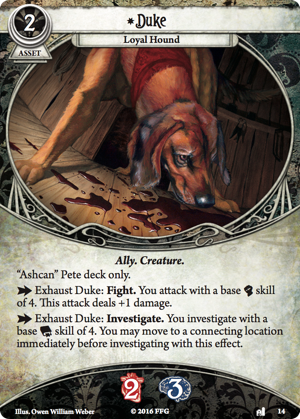
Question for Savatage fans:
Do you hear Duke? He calls.

The other issue is exhausting Duke to take advantage of his action. While both alternatives are strong, one can use only one of them – and only once per turn (so many ones and we aim for much higher numbers!). Here is where the second part  of Ashcan's ability (yes, Pete has two special abilities!4) comes in handy. He can discard a card to ready any asset he controls. While technically speaking it can be used on any of his assets (and you should keep that in mind, just in case) Duke is a very obvious (not to say: evident) choice. A card is not a low cost, obviously, but a double use of Duke is also not a bad gain! 

Please also note, that despite bearing the “ally” trait, Duke does not take the ally (nor any other) slot .

It is rather obvious, that Duke as a signature card has a strength far surpassing any other signature cards. It comes at a cost of being weaker in other areas, though. 

Pete’s Elder Sign effect might easily be the strongest one so far. Reading Duke on top of whooping +2 bonus (yeah, I know it doesn’t matter most of the time, but still better than 0, right?) is a huge boon. To squeeze the full benefit out of it, try to use Duke earlier in the turn.
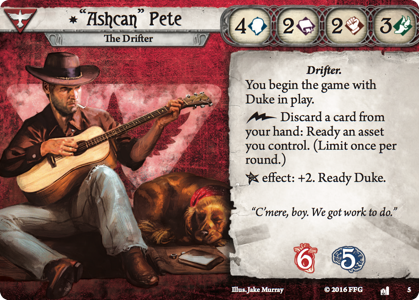
Too bad Ashcan's guitar does not make an appearance.
Pete’s weakness might be very bad or just a minor annoyance (on par with basic weaknesses requiring player to spend 2 actions to get rid of them). It gets very problematic, if it comes up  - and while you cannot spend the actions, particularly if you are engaged with an enemy (it might be even a more serious issue if you relied on the dog services to deal with the enemy). 

Pete’s cards and special ability are very thematic in two ways. First of all, they indeed reflect the nature of a strong symbiosis between human and his trusted animal companion. Secondly, they all orbit around a central “theme” of the character (just like Roland and clues, Agnes and sanity/horror + spells, Jenny and resources and so on).5 They do not bear a good link to the Mythos world, though. The only subnatural link is created in Pete’s weakness, which unfortunately is… not very thematic. I mean, does he have NIGHTMARES in the middle of a scenario? He actually takes a nap? Scenarios are not really portrayed as long journeys; they are quick events, packed within minutes/hours. Not to mention, that one cannot find any connection between nightmares and exhausting assets (even though it does play into the central design idea, as it affect Duke and Pete’s ability). Or is his sleep deprivation suddenly kicking in?6

Strength
Theme

Skill values: Let’s start with a very general and important observation – Pete’s skill values do not sum up to 12, they sum up to 11. It’s obviously done for balancing reasons. Moreover, his total Stamina and Sanity are very low, balanced with Stamina and Sanity of Duke, to a degree. Upon reaching 7 damage/horror Pete is forced to discard Duke, effectively making him 7/7 (though obviously he is not defeated at this stage, though his usefulness is HEAVILY limited).

Luckily for Pete his weaker spots of Lore and Combat (both at 2) are mostly covered with Duke’s capabilities. Obviously Lore and Combat are sometimes tested for other purposes than fight or investigation actions. But they make up a bulk of all related test. Whenever he cannot rely on hound’s competences, Pete can manage fairly well with Agility of 3 and Will of 4. It makes him particularly resilient to most of encounter cards, as well as invites to include spells in his arsenal. To sum up, while the sum of his stats is low, they are distributed in a clever way, adding up to a fairly solid set of stats.

While it makes sense from the gameplay and balance point of view, I cannot find a thematic explanation for a vagabond to be overall weaker than any other investigator - including a teenage girl. Even if the choice of his weaker and stronger sides is rather reasonable.
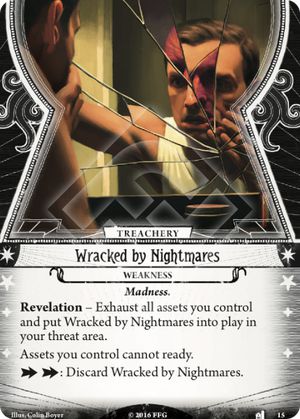
Cards' illustrations have been a hit or miss for me.
This is a clear miss.
 Strength
Theme

Deckbuilding/Class: Survivor cards have a very intangible feel in common. They try to merge few mechanics/concepts – Survivors have circumstantial cards (Fire Axe, Scavenging or newly released Newspaper), some push-your-luck/win-by-failing stuff (absolutely powerful Lucky!, Look What I Found! or Rabbit’s Foot) as well as few evade – related ones (Bait and Switch, Survival Instinct). Obviously there are also some odd cards, not fitting into any of the categories; they make the majority of all red cards, though.

You can very well use the first two categories for when you are forced to rely solely on Pete (up to 2 actions per turn). You are much more prone to fail such tests, thus all the mechanics centred on failing come in very handy. So do the red weapons.  There are not designed to be reliably used on regular basis – Baseball Bat randomly breaks, while Fire Axe costs resources and rarely does extra damage (unless running low resources on purpose, but it’s much more difficult than one might think). Since you are mostly relying on Duke, they support you in case you need to spend more actions fighting. You achieve similar goals in the investigation department with cards like Newspaper. Scavenging comes up useful in completely opposite way - while using Duke you might manage to succeed by 2 every now and than to use the card.

The major flaw when it comes to Survivor cards is their talent - Dig Deep. Since Pete mostly wants to fight or investigate, boosting 2 other stats does not help too much. In fact, you should consider including 1-2 copies of other talents in his deck.

Pete can also take advantage, even more than other characters, of the neutral cards, particularly the double icon skills, to help himself perform some actions on his own.
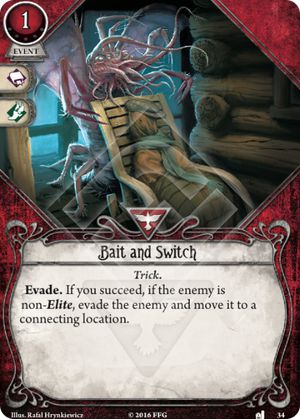
While Pete can quite effectively evade as a last resort,
whole group of evasion-related cars do not fit him too well.

When it comes to 5 non-red slots, Pete can comfortably wield spells. With Will of 4, using Peter’s services (very useful anyway as a Sanity sink, particularly for our vagabond due to his low resistance) and having access to Dig Deep (I know, I just criticized it a bit), he can use Shrivelling and/or Rite of Seeking very well. Due to his high Will/Agility, Drawn to the Flame constitutes a good way of clue-gathering. He can be customized to a degree (and even more with the recent addition of Newspaper, if you plan to make him more of a clue gatherer), the out of class cards play a significant role here and unfortunately he is heavily affected by the 5 card limit.

It does sound feasible for a tramp to potentially cross-class as he’s been to many places and gathered a very varied set of experiences for sure. Therefore one feels the smallest thematic disconnection (among all the Dunwich characters) when using diverse set of cards with him.

Strength
Theme


There are multiple factors, adding up for a huge success of AH:TCG. A very significant one (and a one that plays a particularly big role for me) is the great job done with making each investigator feel unique. Even among these strong individuals, Pete clearly stands out as a very exceptional character. His strong relationship with his animal-friend shapes the entire design of the drifter.

He can fill all kind of roles within a team – with correctly chosen set of cards he can be an amazingly effective fighter (who can manage investigating on a very decent level, when no enemies are around), efficient and mobile clue gatherer (perfectly capable of defending himself against low and medium strength enemies) or an all-round guy. It makes him quite similar to Jim (and they both seem not to get the love they deserve within the community).

On top of that, he is also an enormously exciting character to bring to the gaming table. From the moment you create your deck, using him will force you to make choices. During the gameplay, very often you have to make important calls. How to use Duke? How to ensure you can remain operational once Duke’s exhausted (or – which card to use to ready him)?. Same goes for assets.You will most likely try to use as few as possible, to spend as many actions as possible actually achieving game goals (a strategy well aligned with the capabilities of the Pete-Duke duet). You can reliably accomplish a lot just with Duke - not everything however. You have to make trade-offs, as well as both long and short term plans. You are kept on your toes from the very first action of the game. 
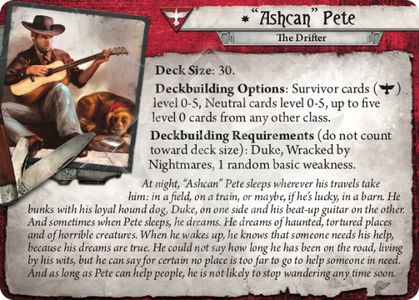

Pete has no surname, just a nickname. Apparently sold it for some smokes.

I also have two important notes, which do not seem to fit anywhere else in this post and that are definitely worth including here.

Firstly, surprisingly enough, despite starting stronger than any other investigator3 (yes, 3 again), Pete does not lose much of the momentum along the game6. He might not be able to create some abusively strong setup in the late game, but definitely does not suddenly get inadequately weak and unable to cope with scenario’s challenges.

I have also noticed, I am not capable of playing Pete as well as my wife, who just squeezes full potential out of this dude. It led me to a more general notion - Pete is one of the characters, who require :
1. Adapting to a specific playstyle
2. Fit with the personality in the first place. Not everyone would even want to change the way of playing to accommodate for Pete's/Duke's needs.

Strength
Theme


1 Bit of the irony in the name, huh?

2It’s bit of a general point about card games in general. Whatever we can use some general deck-typology from the general card game lore and successfully apply it to AH:TCG remains an open question – particularly at this stage of its life, before we’ve seen at least a sizable amount of cards. 

3Using Magic: the Gathering terminology every Pete’s deck is an “Aggro deck”.

4And so does Jim. One might argue, it is Jim’s Elder Sign effect having 2 benefits. Regardless of the outcome of such debate, he has 3 abilities, where others have 2. 

5It seems to be a strong point of focus for AH:TCG designers. Many characters do have a leitmotif or at least a relationship between their design bits (see Wendy’s amulet, used again in Elder Sign effect and it’s interaction with her weakness). I am also planning to write a short note about different aspects of being “thematic”.

6I know the feeling, believe me. You wake up sleepy, somehow manage to overcome the otherworldly forces trying to suck you into the dimensional portal known as bed. For an hour or two you manage to be fully operational, just to suddenly succumb to irresistible sleep-curse.

7We might call it, again referencing M:tG terminology an aggro-midrange deck.

Thursday, 9 February 2017

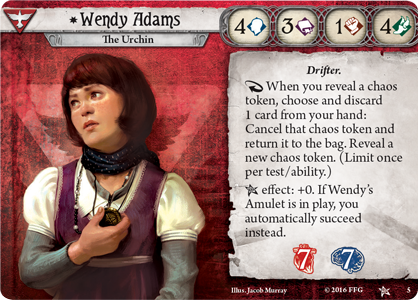
Wendy Adams: The Urchin


Wendy’s backstory is one of the most classic Mythos clichés, nicely put into a gaming experience. Woman is driven insane by the Mythos forces (and the added irony, since some of her actions clearly made sense, but were seen as completely crazy by the “regular folk”). As a result she ends her life in a mental institution. On top of ruining her life, it also destroys life of Wendy, who after spending few years in an orphanage chooses to live on a street.  


Legacy: Wendy is present in all Arkham File Games. Her design is always centered about being resistant to negative effects thrown at her by the game. Her tough life hardened her will, while also teaching how to hide in the shadows without being detected. This idea is still present in AH:TCG, albeit maybe not so strongly present as in the previous installments of the series.

Another defining aspect of Wendy is her Elder Sign necklace – the only thing left to her by her mom.

Isn't it fun, that both Wendy and Jenny are drifters?

 Skill Values: This is where the design of the sneaky and strong willed urchin begins. With Agility and Will of 4 she is suited like no one else to resist all the dangers of the encounter deck. She will suffer the negative consequences of having to deal with Treachery cards the least of all the characters and can instead focus on progressing the investigation. Additionally, she has solid value of both Stamina and Sanity, protecting her from ending her adventure prematurely.  This is perfectly in line with the previous vision of Wendy as a resistant, cunning character.

She is absolutely terrible at classic fighting though, as her Combat value is 1. While she can somehow boost it with Hard Knocks and one of the Survivor Weapons, it’s not a long-term solution, she could consistently employ. Instead she is forced to rely on alternative means – Backstab, evading etc. It makes the job of handling the bosses tough, though manageable – biggest issues arise if she is forced to kill multiple enemies on a regular basis (see: Acolytes in the second scenario)

Finally with her Intellect of 3 she is managing investigating fairly well, too (apparently she’s rather a clever child), her only weakness is… well, physical weakness.

Strength

Theme

Special abilities: The resistance to possible mishaps is also represented through Wendy’s special ability. It allows her to redraw a Chaos Token, possibly saving her from the consequences of a failed skill check. Very often it can be used to save a potentially lost action (failed attack, investigation etc.), making her ability another member of the “free action” set. It comes especially handy if you invested a lot in the test – committed icons, spent resources etc.

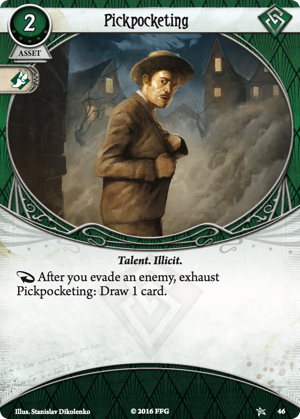
To be able to use her ability whenever needed, you should ensure, you have a steady supply of cards – luckily not only Survivor cards are beneficial here. Pickpocketing (which she can include in her deck) is also helpful.

While dodging Deep One's blows, Wendy also got his wallet


A central theme to the Survivor cards is “push your luck” mechanism. You underinvest icons in hope of a good draw – if the Chaos Bag turns out not to be kind enough, you use Lucky! or Look what I found! to succeed against the odds (or a Rabbit Foot, to still squeeze some benefit out of a failed test).  The benefit of such approach is – in case you were lucky enough not to need Lucky! (irony intended) you keep the resources, instead of committing them in advance. Wendy’s ability fits the same niche – you pray not to have to use it, but can preserve resources/cards knowing, that if the worst happens, you get another shot.

The Elder Sign effect is pretty much another “0” in the Chaos Bag. Chances that having the Amulet (thus making it an auto-success) will somehow make any difference are very slim. If it happens, however, it’s most probably another case of her being saved from a bad negative effect; making it a very thematic experience.


Strength
Theme

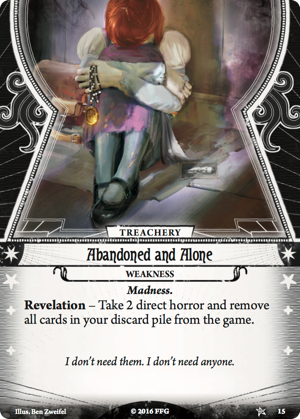
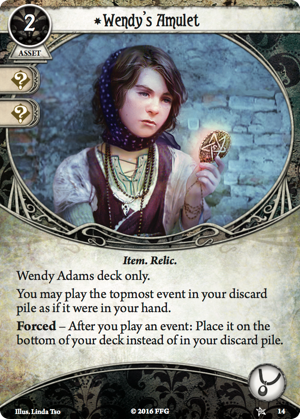
Signature cards: You can't only consider one of Wendy's signature cards at once. They exist in a connection with each other, creating an amazing dynamic. Wendy's Amulet allows you to play events from the discard pile, while her weakness removes the discard pile from the game (on top of inflicting 2 horror) which in result robs you of the events and (almost – see tricks further) all of Amulet's power.

To both achieve this interesting dynamic and prevent the abuse of the Amulet, its text stipulates for played events to go to the bottom of the deck, instead of the discard pile. It means each card will only be replayed once. Also, once you play the amulet, you can't gather more events for later re-use.

It once again leads to a push-your-luck dynamic. With the Amulet on your hand you can either create a pile of events (hoping to recycle lots of them later on), or settle with quick play of the amulet to ensure you'll take advantage of its power, before the dreaded weakness comes in.

One of the weakness, you actually prefer to draw early


There are three problems with the Amulet itself. Firstly, it is rather costly, on top of the events you plan to reuse (Backstab, Elusive, Look What I Found!... only Lucky! seems rather cheap) it uses lots of resources. Secondly, the events are lined up in a given order, so either you plan carefully a way to use them (which is sometimes hard and sometimes next to impossible) or force yourself to use them later on, playing sub-optimally. If you somehow need to play a more situational event (Elusive let's say) or commit one for icons, it lands on top of the discard pile and can easily prevent you from reusing any events at all. And last, but not least, it shares the slot with Rabbit's Foot. It all causes me to commit the Amulet surprisingly often for the juicy 2 Wild icons.

Here are the promised tricks. The general one is - even once the Amulet is in play you can still put events in discard pile and reuse them! You just need to either commit them, or use for Wendy's ability. You can even do sort of two at once! Commit Look what I found and if you still fail the investigation – play it from the discard pile! Discard any event for the Wendy's ability and then play it using her amulet. So in fact, the amulet interacts with Wendy's Special Ability, Elder Sign effect and weakness! It also builds up on the event-heavy nature of Survivor deck. Nice!

Other than the nasty interaction with the Amulet, Wendy's weakness is not a major deal, really.

While the interaction between the cards is cool and creates tons of fun tricks to use, due to its limitations it is not a superb card. In fact, my wife believes it's a very poor one. It certainly is one that does not meet huge expectations you build upon just reading its text.

The Necklace provides light in the dark.
Literally and metaphorically.


Strength
Theme


Class/Deckbuilding options: Two main themes of Survivor class are – evading and Push-Your-Luck. It is easily seen in the cards, almost exclusively centered on this topic. Whenever Survivor cards do not fit your approach to evading, you can find some replacements within the Rogue class, toppled with absolutely powerful Pickpocketing. Unluckily, at this moment the most useful Rogue cards (even more useful for Wendy, to who surprisingly often struggles with resources and could use another Push-Your-Luck card – Sure Gamble) are outside of her reach. (Cat Burglar is worth considering, though, despite her access to Leo) Rogue weapons are not particularly strong either to help her with her low Combat, so I’d rather rely on Survivor options for the rare instances of fighting (Backstab helps a LOT, though, basically main way to deal with the big guys, save Double or Nothing for it!).

Since Wendy is not really a fighter, she does mostly investigating job (and some odd jobs like dealing with Locked Doors, spawning cultists in the 2nd scenario etc.), thus lack of cards to help with investigation in a rogue deck hurts a bit.

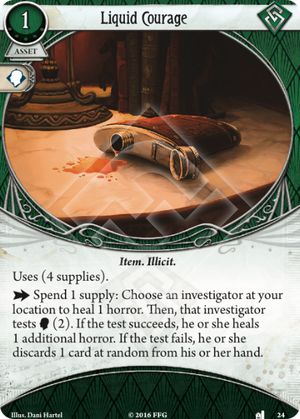
As Rogue cards are the other set helping with evading (and similar enemy dodging tricks), it fits Wendy’s profile quite nicely. I sometimes struggle though with thematic explanations of her pulling out Liquid Courage, Hard Knocks or a Derringer

Despite The Prohibition, even Children abused strong Liquors

 Strength
Theme


Wendy seems to fit a role, that some of players see as assigned to Skids. She can deal with minor tasks, while dodging the enemies on her way. The Urchin has tons of ways to avoid fighting, while remaining efficient. It seems that designers are on their way to boost evading (Bait and Switch is the Exhibit A here, as with good planning it might be just as good as killing a monster), so we can hope for her to get even stronger with upcoming cards.

The Arkham Files game always had some troubles adjusting for an Urchin. Despite some attempts (Lower Sanity Stamina values in Arkham Horror, for instance) the limitations seem not to portray playing a child (or a teenager if you prefer) too well. It is a sacrifice done for the gameplay reasons (otherwise her card choice would be too limited for creating an interesting and strong enough deck).


Strength
Theme


 All images are courtesy of cardgamedb.com and fantasyflightgames.com

Sunday, 29 January 2017

Agnes Baker: The Waitress


A waitress by day, a powerful sorceress by night.

While Agnes seems to be just a shy waitress, there is more to her than meets the eye. She used to command forces of seemingly unlimited power bringing doom to her foes. Even though she's scared of these memories and the power they bring, she will not hesitate to use it against the evil forces, threatening to destroy mankind.

Legacy: Agnes has always been designed as one of the most proficient spellcasters (if not the strongest one indeed). Her stats were maxed for handling the arcane, her abilities were either strengthening her spells (Arkham Horror), enabling her to gain more of them (Eldritch Horror) or making it easier for her to successfully cast them (both). She was considered one of our favourite characters1.

Her vision is no different in AH:TCG – her stats make her a perfect spell-casting monster-wracking machine. Both her class and her signature card encourage building her deck around spells, too.


Skill Values:

As I've already mentioned, Agnes is born to wield the art. Will of 5 precisely defines her area of interest. Each time she is to use a spell you can be sure it'll be cast at a proficient level. Both her Combat and Intellect are negatively affected by this specialization - with a value of 2 (lowest Intellect so far, along with Zoey) she needs to rely on magic for both fighting and discovering clues.

Agility of 3 helps Agnes in two ways. It allows her to evade enemies, while she's gathering and playing her magical assets. Secondly, together with her superior Will, it provides her with a great protection against the Encounter Deck. This is exactly what a witch needs.

Such specialization allows her to handle all kinds of situations perfectly with an appropriate spell If she fails to draw the correct one, however, Agnes can easily find herself in troubles. This is exactly what a pure spellcasting investigator should look like, though.

Strength
Theme

Special abilities:

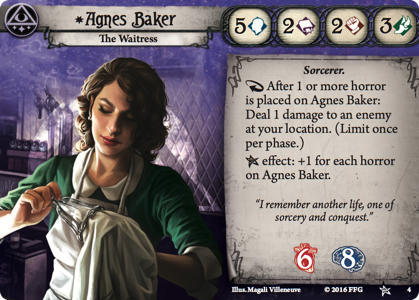
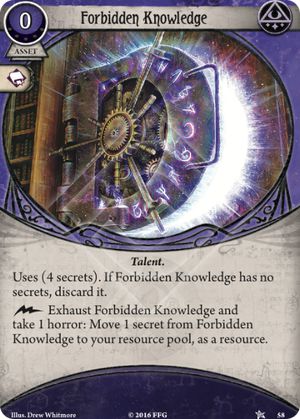
Agnes’ ability enables to put her sanity loss to a good use, dealing damages to enemies. First of all, it allows her to get a benefit from purely negative costs – sanity lost on casting spells, using Forbidden Knowledge etc. Secondly, it allows her to strike back, when attacked in the enemy phase (her ability works once each phase!). Last, but not least, when she’s left with no means of fighting, she can at least do some damage with her ability.

Unlike Roland’s or Wendy’s ability, Agnes’ power needs careful planning, particularly during the deck creating. It is worth to create as many opportunities to use it as possible, even more so if you can decide yourself when the sanity loss occurs (like in the case of aforementioned Forbidden Knowledge). Consider using some sanity recovering cards (Fearless, Clarity of Mind).

You must also carefully plan using the ability, while playing. Remember about the limitation and do not decide to lose sanity, before it’s necessary. First check if spell caused you to take horror, before you do action, which outcome is surer.

All in all, her skill might come extremely handy in sniping one-health enemies, or wearing down bosses. Enemies are bread and butter of AH:TCG, hence it is used quite regularly. Still it comes with constraints, as Agnes Sanity is not limitless and sometimes she is forced to take horror without benefiting out of it.

Also, one easily missed rule – horror must be placed on Agnes, not one of her assets to trigger the ability. Therefore I almost always put all the remaining horror on assets (unless it’d destroy them).

Absolute must-have in every Agnes' deck.
provides means of playing her expensive assets.
And deals damage whenever you need it.
I still remember reading Agnes’ ability for the first time and struggling to understand, what it is supposed to thematically represent. Unlike most of the abilities it does not have a very clear connection between the gameplay result and the thematic event it is supposed to symbolize.

A picture started to slowly appear in my mind, when I was reading descriptions of the spell cards. Just like in previous Arkham Files games, Agnes casts spells with an added efficiency, dealing extra damage. Even more of an individualized meaning emerges upon reading her story. I imagine taking horror uncovers previously locked (suppressed) parts of her memory, containing unnatural arcane knowledge. Using the freshly regained wisdom, Agnes slays every evil being opposing her. One must really appreciate this sophisticated yet precise design.

Agnes’ Elder Sign effect is rather a boring one. It pretty much follows Roland’s design – unnecessarily high positive modifier. It’s consistent with the “theme” of horror and the idea of Agnes growing stronger through unlocking her memories.

Strength

Theme 


Signature cards:

Agnes’ signature card seems not to get too much love around. I could easily understand that sentiment earlier on – it wasn't particularly strong with only base set cards around. There were too few spells available to regularly benefit from her necklace. Dunwich Legacy, however, brought 2 more level 0 spells and additional one with level of 2. Now you can easily have 8-10 Spell cards in your deck, which might result in drawing quite a number of additional cards.

It still has some drawbacks, though. Necklace is far less useful if drawn later on, almost making it an auto-commit (and its icons are not too impressive). It is also rather a costly asset. Moreover, Agnes has access to two other assets for the Necklace slot – Rabbit's Foot and Holy Rosary. Particularly the latter is tough to pass on, as it boosts her Will. Ironically, using her precious Hyperborea witch necklace makes her less potent at spellcasting.

While it's a great reference to Agnes’ story about the recently discovered Hyperborean artefact, her signature card is not an overwhelmingly thematic card due to its questionable interaction with Holy Rosary.

You should have listed to your mom when she said:
"Don't play with magic!"


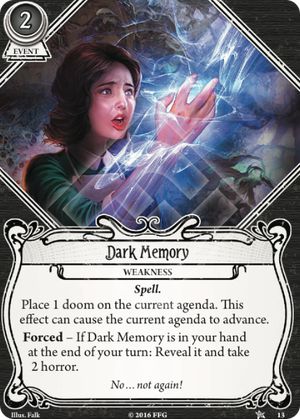
I very much like the design of Agnes' weakness. It's a spell, very clearly on the dark magic side of the sorcery. Even though it is a weakness, it might be used to your advantage. If you decide to postpone playing it, you might make use of Agnes' ability. It comes at a hefty cost of two sanity (so basically double the cost), yet when back against the wall, you might consider it a good trade. When you decide to play it, you might just take advantage of Heirloom of Hyperborea to replace the drawn weakness with a "real" player card. Still these options are just a minor consolation price, when you realize you just payed two resources and an action to add a doom token. And you can't play it cleverly, timing it in a way that would not hasten agenda's progress, as the card clearly states it can cause agenda to advance.

The thematic implications of the gameplay options mentioned above create a great thematic experience. Even just the straightforward results are quite thematic. They remind you, that you can't use magic without paying its cost. In the end it always works for the benefit of the evil forces, advancing their agenda.

Strength

Theme 


Class/Deckbuilding options:

Choice of Agnes’ class is rather obvious, considering her spellcasting theme. The addition of a Survivor subclass creates a very interesting mix. It does not only match very well thematically (Agnes is just a simple Waitress, who just become aware of her previous life). It also provides her with great deal of useful cards.

Main problem with playing Agnes is – you usually cannot do well in a given area without an appropriate spell. Without Shrivelling or Blinding Light you struggle with enemies. Without Rite of Seeking you have hard time investigating etc. Here red cards come as a perfect help. Survivor weapons are suboptimal as a first choice, but perfect if you add them to increase a chance of drawing anything to handle enemies, while biding your time and waiting for stronger options. Both Baseball Bat and Fire Axe have their downsides, yet are able to provide decent enough bonuses to Combat to offer Agnes fair shot at fighting. Look what I found cannot be the long term source of clues, but makes it possible to do some investigation, while waiting for purple cards to come to your hand.

Some other survivor cards match her needs as well – Lucky! is one of the strongest events in the game, so no surprise there (and the upgraded version helps going through the deck), but you might also consider a Leather Coat to help with her slightly lower Stamina or 2XP version of Peter Sylvestre to help with spellcasting, some evasion cards allow to allow her for sneaking around if you choose to… list of matching cards is truly astonishing.

Strength 
Theme 


Agnes is a perfect thematic representation of a magic user, who is almost powerless without the arcane forces. First Mystic character sets high standards for the next ones and proves fun and efficient, even more so with the freshly expanded card selection.

Powerful card by itself with an added synergy with Agnes' ability.


I am waiting to see bit more punch for the fight capabilities of spellcasters. Once it’s there, I am sure Agnes will excel at it, just as she excels at all other areas of magic. You can shape her according to your preferences – while making her the main fighter is pending arrival of another monster-wracking spell, she can easily handle investigation (with a combination or Rite of Seeking, "Look what I found!" and my absolutely favorite Drawn to theFlame), be an all-round or a support investigator.

Strength 
Theme 

1For both Arkham Horror and the Eldritch Horror we come up with a drafting idea to ensure – good balanced team and sharing the characters quite evenly, when it comes to the fun factor (we usually play 3 each). We first draw 3X investigators, where x is number of investigators each of us controls. Than we choose a team, making sure we have appropriate number of fighters, gate closers, support etc. Once they are selected, one person chooses one investigator to play, the other chooses 2, again first person chooses 2 and the third gets assigned automatically.

2It is sometimes overlooked, that drawing a weakness not only forces you to deal with it, but also robs you of a player card.

All images are courtesy of cardgamedb.com and fantasyflightgames.com